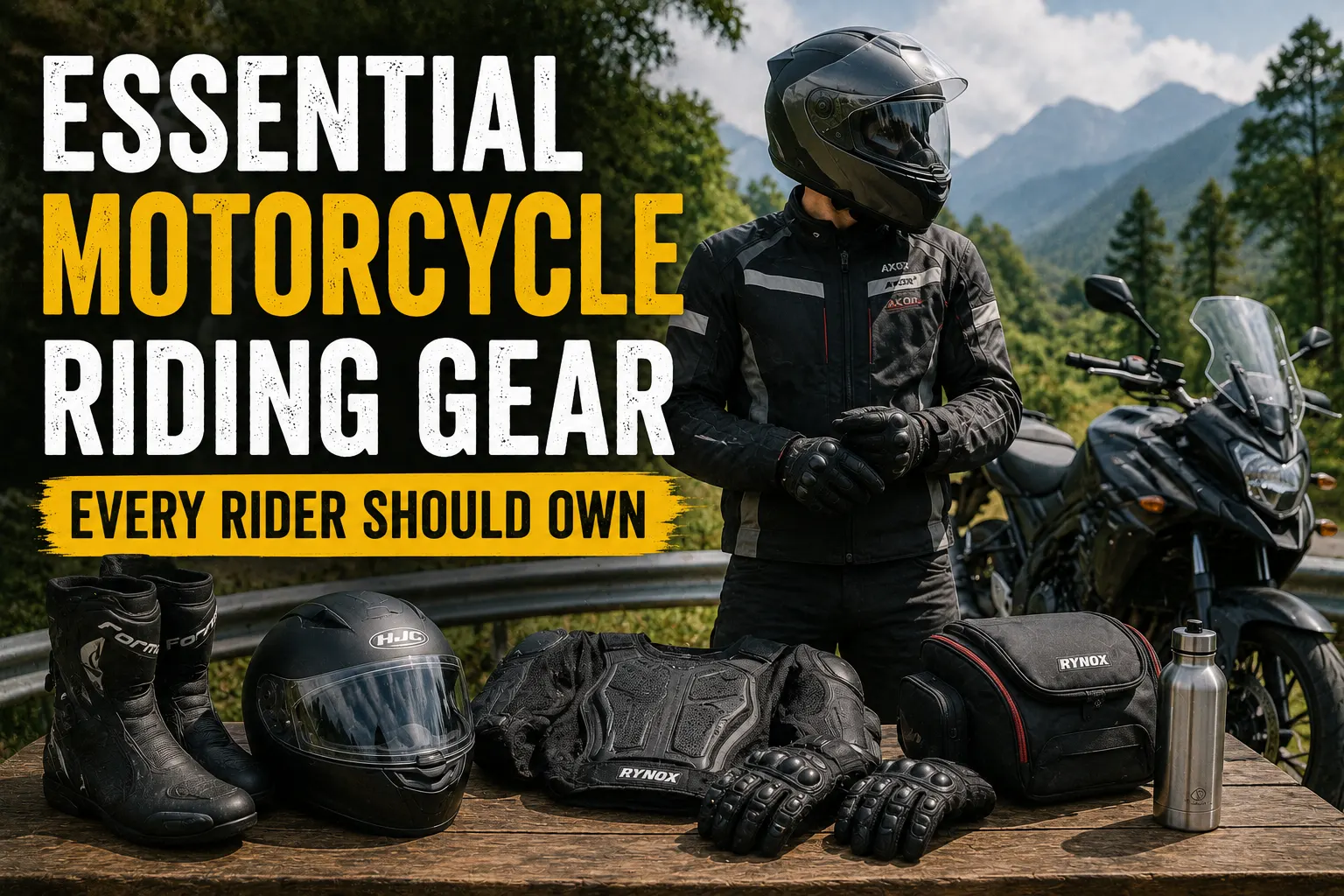
Essential Motorcycle Riding Gear Every Rider Should Own
Ridivo Team
·20 June 2026
Essential Motorcycle Riding Gear Every Rider Should Own
There's a saying among riders: dress for the slide, not the ride. The tarmac doesn't care how short your trip is or how careful you are — and the difference between a graze and a skin graft is almost always what you were wearing. Good motorcycle riding gear is the cheapest insurance you'll ever buy, and the one upgrade that pays for itself the first time you need it.
This is a head-to-toe guide to the riding gear essentials every rider should own — what each piece does, what to look for, and how to build a solid setup without spending a fortune.
Table of contents
- The head-to-toe essentials
- Riding jackets
- Riding gloves
- Riding boots
- Riding pants
- Knee guards
- Rain gear
- Base layers
- Touring accessories
- Budget setup recommendations
- FAQ
- Conclusion
The head-to-toe essentials
Before the detail, here's the core kit every rider should build toward, top to bottom:
- Helmet — the single most important piece (covered in its own guide)
- Riding jacket — with CE armour at shoulders, elbows, and back
- Riding gloves — knuckle protection and a secure wrist strap
- Riding pants — abrasion-resistant, ideally with hip and knee armour
- Knee guards — if your pants don't have built-in knee armour
- Riding boots — ankle protection and a stiff sole
- Rain gear — a packable waterproof layer
- Base layers — for temperature control on long rides
Your helmet is the priority buy — see our Motorcycle Helmet Guide for how to choose it. This article covers everything below the neck.
Riding jackets
The riding jacket is the workhorse of biker safety gear — it protects the largest area of your body in a slide.
What to look for:
- CE-rated armour at the shoulders, elbows, and (ideally) the back. Armour is rated CE Level 1 or Level 2, with Level 2 absorbing more energy.
- Abrasion-resistant shell — leather for maximum protection, or a quality textile for versatility and airflow. Textile jackets are often rated under the EN 17092 system (AAA, AA, A) by protection class.
- Ventilation for Indian heat — intake and exhaust vents that move air through the jacket.
- A removable thermal liner so one jacket works in both highway heat and ghat cold.
- A good fit — snug enough to keep the armour in place, with room for a base layer underneath.
A vented textile jacket with CE Level 2 armour and a removable liner is the most versatile single choice for most Indian riders.
Riding gloves
Your hands hit the ground first in almost every fall — it's instinct. Proper riding gloves are non-negotiable, even for short rides.
What to look for:
- Knuckle protection (a hard or reinforced knuckle guard).
- Palm sliders and reinforced palms to survive abrasion.
- A secure wrist strap so the glove can't be torn off in a slide.
- Full-finger coverage — never ride in fingerless gloves.
- A waterproof pair as a second set if you ride in the monsoon.
Get the fit snug but not restrictive, with enough dexterity to work the controls comfortably.
Riding boots
Sneakers offer no protection to the most vulnerable part of your lower body. Riding boots guard your ankles, feet, and shins.
What to look for:
- Ankle coverage that rises above the ankle bone.
- A stiff, oil-resistant sole with good grip.
- Reinforced toe and heel, and ideally ankle armour.
- A secure closure (laces tucked away, or buckles/Velcro).
Touring boots add waterproofing and all-day comfort; even a basic pair of proper riding shoes beats sneakers by a mile.
Riding pants
The forgotten essential. Plenty of riders armour their top half and ride in jeans — but ordinary denim shreds in seconds on tarmac.
What to look for:
- Abrasion-resistant fabric — riding-specific textile or reinforced riding jeans (with aramid/Kevlar lining), not regular denim.
- Hip and knee armour, CE-rated, in the right pockets.
- Ventilation and a comfortable riding cut that doesn't bunch when you sit on the bike.
Riding jeans are the easy entry point — they look normal off the bike but offer real protection on it.
Knee guards
If your riding pants don't have built-in knee armour, separate knee guards are an inexpensive, high-value addition. Knees are common impact points and slow to heal.
- Strap-on knee guards are cheap, easy to fit over normal clothing, and a great starting point for new riders.
- CE-rated guards offer certified protection.
- Make sure they stay put — guards that slide down in a crash do nothing.
Rain gear
In India, rain prep isn't optional — a clear morning can turn into a ghat downpour by noon.
- A packable two-piece rain suit that fits over your riding gear.
- Waterproof gloves or covers, and waterproof boots or covers.
- A dry bag to keep your luggage and electronics dry.
- An anti-fog visor insert for the helmet.
Keep the rain layer packed on every long ride, even when the sky looks clear. For the full pre-ride list, see our Essential Motorcycle Touring Checklist.
Base layers
The unseen layer that makes long rides comfortable. Base layers regulate temperature and wick sweat.
- Moisture-wicking base layers keep you dry and cool in the heat.
- Thermal base layers add warmth on cold pre-dawn and high-altitude rides without bulk.
- A neck tube / balaclava keeps dust and cold out and adds comfort under the helmet.
Good base layers let one jacket span a wide temperature range, which is exactly what Indian touring demands.
Touring accessories
Once the protective basics are sorted, these accessories make long-distance motorcycle touring gear complete:
- A sturdy phone mount for navigation.
- Luggage — saddlebags, a tail bag, or a tank bag (keep weight low and central).
- A hydration pack so you drink without stopping.
- Earplugs to cut wind noise and fatigue on long highway days.
- A power bank and charging cables, kept dry.
For navigation and group coordination, Ridivo ties these together: build the ride with waypoints and pitstops, download offline maps for low-signal ghats, share live location so the group stays together, and rely on the skill-aware SOS — which routes an emergency alert to the nearest rider with first-aid or repair skills. For the rules of riding together, see our Group Riding Safety Guide.
Ride smarter with your crew
Live tracking, SOS alerts, route planning — built for Indian motorcycle and cycling groups.
Join the waitlistBudget setup recommendations
You don't need to buy everything at once. Build in priority order, best-protection-first:
- Helmet — never compromise here (see the helmet guide).
- Gloves — cheap, high-impact protection for the most common injury.
- Riding jacket — the biggest coverage upgrade for your money.
- Riding pants or riding jeans — close the gap most riders ignore.
- Boots — proper riding shoes over sneakers.
- Knee guards, rain gear, base layers — round out the kit over time.
Tiers for the Indian market:
- Entry: Indian brands like Studds, Steelbird, Rynox, and Aspida offer solid CE-armoured jackets and gloves at accessible prices.
- Mid-range: Rynox, Royal Enfield, Solace, and similar offer better materials, ventilation, and touring features.
- Premium: Alpinestars, Dainese, and other international brands for top-tier protection and comfort.
The smart approach: buy gear in order of protection-per-rupee, and don't skip the pants and gloves to save money — they're where most avoidable injuries happen. Skimping on gear is one of the most common mistakes new tourers make, as we cover in our Motorcycle Touring Mistakes Guide.
FAQ
What motorcycle riding gear do I actually need to start? At minimum: a certified helmet, CE-armoured gloves, and an armoured riding jacket. Add riding pants (or riding jeans), proper boots, and knee guards as you go. Those first three cover the most common and most serious injuries.
Is a riding jacket really necessary for short rides? Yes. Most crashes happen close to home at low speed, and a slide at even 30 km/h can cause serious abrasion. A CE-armoured jacket protects the largest area of your body and is worth wearing every single ride.
Can I ride in regular jeans? Not safely. Ordinary denim shreds almost instantly on tarmac. Use riding-specific pants or reinforced riding jeans with an aramid lining and CE knee and hip armour instead.
What is CE-rated armour? CE armour is impact protection tested to a European safety standard, rated Level 1 or Level 2 (Level 2 absorbs more energy). Look for it at the shoulders, elbows, back, hips, and knees of your gear.
How do I choose riding gear for Indian weather? Prioritise ventilation and removable liners so one jacket handles both heat and cold, add moisture-wicking base layers, and always carry packable rain gear. Vented textile gear with CE armour is the most versatile choice for Indian conditions.
Conclusion
Essential motorcycle riding gear isn't about looking the part — it's about every piece doing a job when it matters most. Start with the helmet and gloves, add the jacket, then close the gaps with pants, boots, and guards over time. Buy in order of protection-per-rupee, gear up for the slide rather than the ride, and you'll get every kilometre of enjoyment with none of the avoidable cost. Dress properly, then go ride.
Ride smarter with your crew
Live tracking, SOS alerts, route planning — built for Indian motorcycle and cycling groups.
Join the waitlist