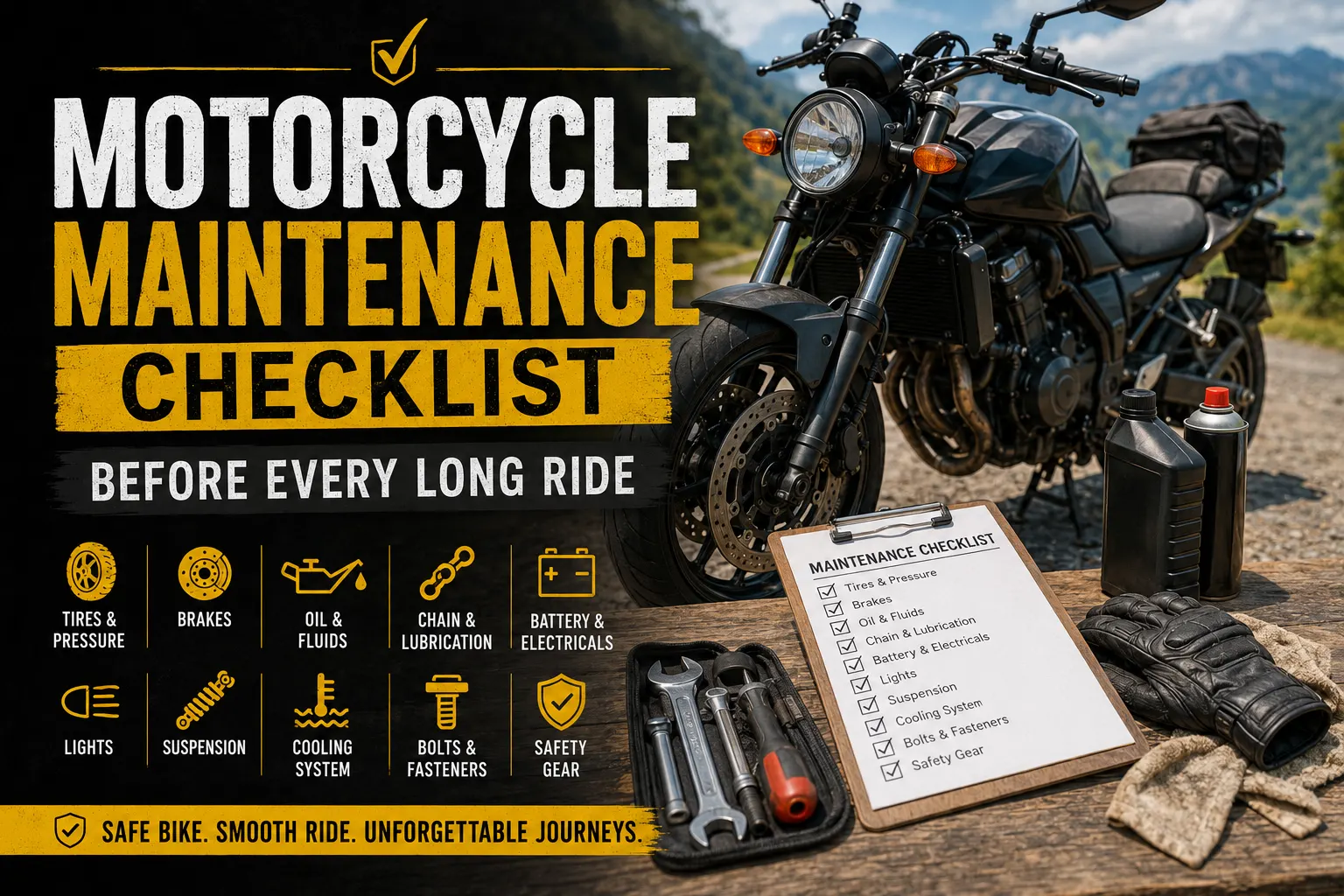
Motorcycle Maintenance Checklist Before Every Long Ride
Ridivo Team
·30 June 2026
Motorcycle Maintenance Checklist Before Every Long Ride
A breakdown 200 km from home almost never comes out of nowhere. The loose chain, the soft tyre, the brake pad worn to the metal — they were all there in the driveway, waiting to be noticed. The riders who tour for years without drama aren't lucky; they just look before they leave.
This is a complete motorcycle maintenance checklist to run before every long ride — a two-minute version for routine departures and a deeper inspection for big tours. Spend a few minutes now and you trade a roadside headache for a smooth day on the road.
Table of contents
- Why pre-ride maintenance matters
- The 2-minute pre-ride check (T-CLOCS)
- Tyres
- Brakes
- Chain and sprockets
- Engine oil and fluids
- Lights and electricals
- Controls and cables
- Bolts, chassis and suspension
- When to get a professional service
- Tools and spares to carry
- The printable pre-ride checklist
- FAQ
- Conclusion
Why pre-ride maintenance matters
A motorcycle has far less margin for error than a car — two wheels, exposed components, and no second chance if a tyre lets go in a corner. A pre-ride inspection catches the small problems that turn into big ones at highway speed or on a remote ghat.
It's also about confidence. Knowing the bike is sound lets you focus on the road and the ride instead of second-guessing a noise. A few minutes of checks is the cheapest insurance in motorcycling.
The 2-minute pre-ride check (T-CLOCS)
Before every ride, run through T-CLOCS — the widely used pre-ride inspection checklist. It's six quick checks you can do in the time it takes to put your gear on.
- T — Tyres: pressure and tread, plus a glance for cuts or bulges.
- C — Controls: levers, throttle, clutch, and cables move freely and snap back.
- L — Lights: headlight, tail light, brake light, indicators, and horn all work.
- O — Oil and fluids: engine oil level, plus coolant and brake fluid, with no leaks underneath.
- C — Chassis: chain tension, suspension, and no obvious loose bolts.
- S — Stands: side stand and centre stand spring back and hold firm.
Featured-snippet target — what is the T-CLOCS pre-ride check? T-CLOCS is a standard pre-ride motorcycle inspection covering Tyres, Controls, Lights, Oil and fluids, Chassis, and Stands. Running through these six checks before every ride catches the most common mechanical problems — a soft tyre, a worn brake, a loose chain — before they become a roadside breakdown.
That covers daily riding. For a long tour, go deeper with the full checks below.
Tyres
Your only contact with the road, and the first thing to check.
- Pressure: set to the manufacturer's recommended PSI when cold. Under-inflation ruins handling and wears tyres fast.
- Tread depth: replace before tyres are worn smooth; low tread is dangerous in the wet.
- Condition: look for cuts, embedded objects, cracks, and uneven wear.
- Age: rubber hardens over years even with tread left — old tyres lose grip.
For a long tour, start on tyres that have plenty of life left; don't set off on a set that's nearly due.
Brakes
The system you'll trust on every ghat descent.
- Pads: check thickness front and rear; replace before they reach the wear line.
- Lever and pedal feel: firm, not spongy. Spongy brakes usually mean air in the line or low fluid.
- Brake fluid: at the correct level and not dark or old.
- Discs/drums: no deep scoring or warping.
If the brakes feel anything but firm and confident, sort them before a long ride, not during one.
Chain and sprockets
The drivetrain that's easiest to neglect and quick to fail.
- Tension: check the slack against the manual; too tight or too loose both cause problems.
- Lubrication: a clean, lubed chain runs smoother and lasts longer. Lube it before a tour.
- Wear: inspect for tight spots, rust, and worn or hooked sprocket teeth.
A snapped or seized chain can strand you completely, so this check earns its place every long ride.
Engine oil and fluids
The lifeblood of the engine.
- Engine oil: check the level and condition; top up or change if it's due or dirty. Don't start a long tour on oil that's near its change interval.
- Coolant: at the right level on liquid-cooled bikes — vital for traffic and hot highway runs.
- Brake and clutch fluid: topped up and not degraded.
- Leaks: look under the bike for any fresh oil or fluid.
Lights and electricals
Especially critical for early-morning, night, or monsoon riding.
- Headlight (high and low beam), tail light, and brake light (front and rear triggers).
- Indicators all four, and the horn.
- Battery: terminals clean and tight, and the bike cranks strongly.
A dead battery or failed light far from home is an avoidable problem — confirm it all works before you leave.
Controls and cables
The connection between you and the bike.
- Clutch and brake levers: smooth action, correct free play, no damage.
- Throttle: opens smoothly and snaps fully closed on its own.
- Cables: no fraying, kinks, or stiffness; lubricated where needed.
Sticky or frayed cables get worse under the demands of a long ride, so address them first.
Bolts, chassis and suspension
The structure that holds it all together.
- Fasteners: check key bolts (axles, engine mounts, handlebar, foot pegs) are tight. Vibration loosens them over time.
- Suspension: forks and rear shock move smoothly with no leaks.
- Wheel bearings and steering: no play or notchiness.
A quick once-over here catches the rattles before they become failures.
When to get a professional service
Some things are best left to a mechanic before a big tour:
- If a service is due (by distance or time), do it before the trip, not after.
- For brake bleeds, valve checks, fork oil, and coolant changes if you're not equipped to do them yourself.
- For any persistent noise, warning light, or handling change you can't diagnose.
A pre-tour service a week or two before departure leaves time to fix anything it uncovers — and to do a shakedown ride before the real thing.
Tools and spares to carry
Even a well-maintained bike can have a roadside moment. Carry enough to handle the basics:
- A basic toolkit matched to your bike's fasteners
- A tyre puncture repair kit with a mini compressor or CO2 inflator
- Spare clutch and brake levers for ghat rides
- Zip ties, duct tape, and wire for quick fixes
- Chain lube for longer tours
- A tow strap and a small torch
Even with all this, a breakdown on a remote ghat or forest road is when staying connected matters most. Ridivo helps your group stay together with live location and a skill-aware SOS that routes an emergency alert to the nearest rider with repair or first-aid skills — so help comes from the person best placed to give it. For the full kit list, see our Essential Motorcycle Touring Checklist.
Ride smarter with your crew
Live tracking, SOS alerts, route planning — built for Indian motorcycle and cycling groups.
Join the waitlistThe printable pre-ride checklist
Run this before every long ride:
| System | Check |
|---|---|
| Tyres | Pressure (cold), tread, cuts/bulges |
| Brakes | Pad thickness, firm lever, fluid level |
| Chain | Tension, lubed, sprocket wear |
| Oil & fluids | Oil level/condition, coolant, no leaks |
| Lights | Head/tail/brake lights, indicators, horn |
| Controls | Levers, throttle snap-back, cables |
| Chassis | Key bolts tight, suspension, bearings |
| Stands | Side and centre stand spring back |
| Spares | Toolkit, puncture kit, levers, lube |
Skipping these checks is one of the most common — and most avoidable — touring mistakes, as we cover in our Motorcycle Touring Mistakes Guide. And once the bike's sorted, make sure your gear is too with our Riding Gear Guide.
FAQ
What should I check on my motorcycle before a long ride? Run the T-CLOCS check: tyres (pressure and tread), controls (levers, throttle, cables), lights (all of them plus the horn), oil and fluids (level and leaks), chassis (chain tension and bolts), and stands. For a long tour, also check brake pads, chain lubrication, and coolant, and carry a basic toolkit and puncture kit.
How often should I service my bike for touring? Follow your manufacturer's service interval, and always do any due service before a long tour rather than after. Schedule it a week or two ahead so there's time to fix anything it reveals and do a short shakedown ride.
What is the most important pre-ride check? Tyres and brakes are the two most safety-critical: correct tyre pressure and tread, and firm, confident brakes with healthy pads. They're your grip and your stopping power, so never set off if either is in doubt.
What tools should I carry on a long motorcycle ride? A basic toolkit for your bike, a tyre puncture repair kit with an inflator, spare clutch and brake levers, zip ties and duct tape, chain lube, and a tow strap. Practice using the puncture kit once at home before you need it on the road.
How do I know if my chain needs attention? Check the slack against your manual — too loose or too tight both cause problems — and look for rust, tight spots, or worn sprocket teeth. A clean, properly tensioned, lubricated chain is essential before any long ride.
Conclusion
A motorcycle maintenance checklist before every long ride isn't about being fussy — it's about catching the small stuff in your driveway instead of on a ghat shoulder. Run T-CLOCS before you roll out, go deeper before a big tour, get any due service done early, and carry the basics to handle a roadside fix. Look after the bike, and it'll look after you for every kilometre of the ride.
Ride smarter with your crew
Live tracking, SOS alerts, route planning — built for Indian motorcycle and cycling groups.
Join the waitlist